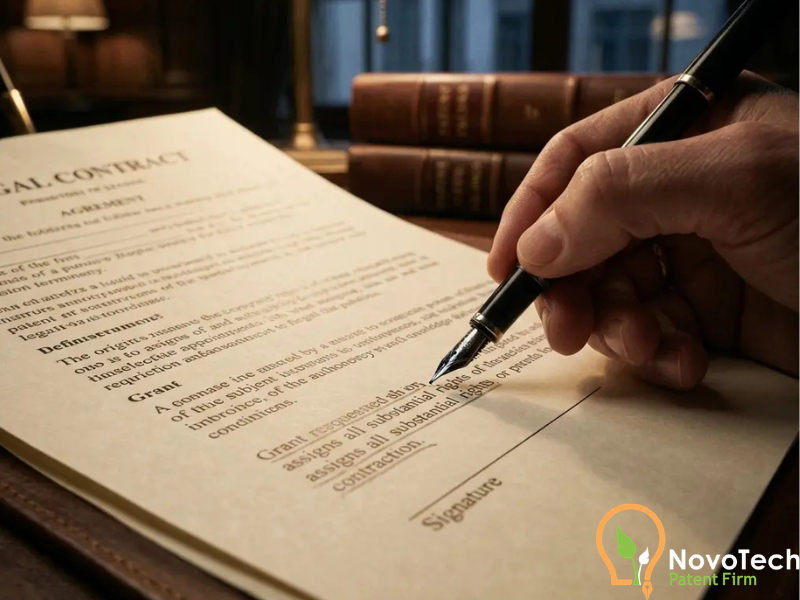
The Licensing Moment: When Validation Becomes Vulnerability
Authored by Babak Akhlaghi on June 21, 2026. You’ve spent years on this. The invention. The prosecution. The real money — not just filing fees, but the kind of investment that makes you check your bank account twice.
And then someone wants to license your patent.
That moment feels like validation. It feels like the finish line. Someone sees what you built. They want to pay you for it. The hard part is over.
That emotional high is exactly when you’re most vulnerable to signing away rights you can never recover.
It happens. A founder who was careful enough to protect their invention at the start, meticulous about claims, strategic about prosecution, walks into a licensing negotiation and assumes the contract is just paperwork. The deal itself feels like proof that everything worked.
And then one clause in that agreement quietly undoes all of it.
Not through litigation. Not through a bad ruling. Just through a contract that wasn’t structured right.
What You’re Actually Granting Away
Patent rights are exclusionary by nature. You have the legal right to exclude others from making, using, selling, or offering to sell the patented invention in the United States, or importing the invention.
These rights can be selectively assigned. You can grant the right to manufacture but not sell. You can grant exclusive rights in one territory and retain them in another. You can carve the patent into pieces.
The problem is that founders may not realize which pieces they’ve given away until it’s too late.
The grant clause, the specific language defining what rights you’re transferring, is where this happens. And in my experience, it’s the provision that should get the most scrutiny during negotiations. So, while as a founder or a startup, you would like to focus on royalty rates, milestone payments, and maybe exclusivity terms, don’t forget the grant clause. Don’t treat it like a boilerplate.
It’s not.
Every patent issued by the USPTO comes with a bundle of exclusionary rights. When you license those rights, you need to be absolutely clear about which ones you’re keeping and which ones you’re handing over. Because the right to sue for infringement is itself an exclusionary right — and if you give it away, you may have no recourse when someone infringes your patent.
The Right to Sue: Why It Matters More Than You Think
Here’s the scenario that should keep you up at night.
You grant an exclusive license. The licensee has the right to manufacture, sell, sublicense, all the commercial rights. You retain royalty interests and maybe some veto rights over sublicenses. It feels balanced.
Then a competitor starts infringing. They’re using your patented technology without permission. Your royalty stream is eroding. Your market position is weakening.
You call your licensee. You say, “We need to sue.”
And they say no.
Maybe they have a business relationship with the infringer. Maybe they don’t want the legal exposure. Maybe they just don’t want to spend the money. Their incentives are completely different from yours.
And you, the person who invented the thing, who built it, who fought for the patent, you’re sitting there watching your market erode, and you can’t do anything.
Because you gave away the right to sue.
This isn’t hypothetical. In A.L.M. Holding Co. v. Zydex Industries (Fed. Cir. 2026), patent owners faced exactly this risk. They had granted an exclusive worldwide license covering the rights to manufacture, import, use, sell, and sublicense their warm-mix asphalt patents. When infringement occurred, the district court initially dismissed their lawsuit, ruling they had transferred away all exclusionary rights and lacked standing to sue.
The Federal Circuit reversed. But only because the patent owners had structured the agreement correctly from the start.
They retained the right to sue jointly with the licensee. If the licensee chose not to participate, the patent owners could proceed independently, controlling the litigation and collecting any damages. They also retained veto rights over sublicenses and guaranteed royalty interests from any sublicensee.
The court held that these retained rights, the right to sue, sublicensing control, and royalty interests, established a “non-illusory exclusionary interest” sufficient for constitutional standing.
Had they structured the agreement even slightly differently, they would have had no recourse when infringement occurred.
The Finish Line Trap
The psychological moment when you receive a licensing offer is dangerous precisely because it feels like winning.
You’ve been grinding. You’ve been in prosecution for months or years. You’ve been explaining your invention to examiners, responding to office actions, refining claims. And now someone wants to pay you for what you built.
That validation makes you less likely to scrutinize the terms. The deal itself feels like proof that you did everything right.
Licensing feels like the finish line. But it’s actually where you’re most exposed.
What a Well-Structured Agreement Actually Looks Like
When I review a licensing agreement that’s been done right, here’s what I see:
The grant provision is crystal clear. Not just “exclusive license” but specific enumeration of which rights are being transferred and which are being retained. Territory. Field of use. The right to make, use, sell, import. The right to sublicense. The right to sue.
Performance milestones with consequences. Minimum royalty thresholds. If the licensee fails to meet them, the exclusive license becomes non-exclusive — or terminates entirely. You don’t want to grant exclusivity and then hope the licensee performs. You want recourse built into the contract.
Sublicensing veto rights. Any sublicense must be approved by you as the patent owner. That approval won’t be unreasonably withheld, but it also won’t be automatic. And critically: any royalties from a sublicensee flow to you as if the licensee had made the sale directly. The sublicensee is bound by the terms of your original agreement.
Joint right to sue with a fallback. You and the licensee can pursue infringement together, splitting costs and damages 50/50. But if the licensee declines, you can proceed independently. You control the litigation. You keep the non-participating party informed. And you collect any damages that result.
These provisions aren’t just legal safeguards. They’re a map of every place the relationship could break down.
Because the best licensing agreements are drafted for the breakup, not the honeymoon.
Imagine the Day Your Interests Diverge
Here’s the question to ask every founder before they sign a licensing agreement:
What happens when your interests diverge from the licensee’s?
Not if. When.
The licensee gets acquired by a company that competes with you. The licensee pivots into a different market and stops prioritizing your patent. The licensee develops a workaround and no longer needs your technology. An infringer approaches them about a partnership.
In any of those scenarios, will you still have the ability to protect your invention? To enforce your rights? To collect what you’re owed?
If the answer is no, if your ability to act depends entirely on the licensee’s cooperation, then you’ve structured the agreement wrong.
Here’s the trap: if you grant an exclusive license with “all substantial rights,” courts may treat it as an effective assignment of right to sue, meaning the licensee can sue for infringement, but you cannot. The patent owner retains standing to sue only by keeping sufficient exclusionary rights. The distinction between a license that preserves your enforcement power and one that strips it away often comes down to granular contract language that founders overlook in the excitement of closing the deal.
The Cost of Getting It Wrong
Patent litigation is expensive. Legal defense costs can run into the hundreds of thousands or millions. Injunctions can shut down your product. The distraction from an active lawsuit can cripple a startup’s momentum at exactly the wrong moment.
But here’s what’s worse: facing all the economic harm of infringement with none of the legal tools to stop it.
When you give away enforcement rights to a licensee who then refuses to act against an infringer, you’re subsidizing the infringer through lost royalties. The licensee maintains whatever business relationship serves their separate interests. And you have no recourse.
I don’t know how often this happens. But even once is too many.
You work hard to invent something real. You invest significant money to obtain the patent. None of that has been easy. And then one provision in a licensing agreement, one clause you didn’t fully understand, quietly strips away your ability to protect what you built.
What to Do Before You Sign
If there’s one takeaway from this, it’s this: slow down.
When you’re facing a licensing negotiation, when someone is offering to pay you for your patent, when it feels like validation and the finish line, that’s exactly when you need to pause.
Read the agreement carefully. Not just the royalty terms and the exclusivity provisions, but the grant clause. What rights are you actually transferring? What are you retaining?
Ask yourself the tough question: What happens when my interests diverge from the licensee’s? What are my recourses then? Am I comfortable with those remedies?
And involve a seasoned patent licensing attorney. Not a generalist. Not someone who handles patent prosecution but has never negotiated a licensing deal. Someone with deep experience in patent licensing who understands standing requirements, exclusionary rights retention, and enforcement mechanisms.
These agreements are not boilerplate. They’re not like buying or selling a house where the forms are standardized. They’re deeply customized, and a single provision can give away rights you didn’t intend to give, or leave substantial revenue on the table.
If you were prudent enough to protect your invention at the start, be prudent enough to protect it at the licensing stage too.
The Real Finish Line
A licensing agreement isn’t the end of your patent journey. It’s a new chapter in how you monetize and protect what you’ve built.
Done right, licensing can be transformative. It can validate your technology, generate revenue, and expand your market reach while you retain meaningful control over enforcement and future opportunities.
Done wrong, it can quietly strip away the very rights you spent years fighting to secure.
The difference between those two outcomes often comes down to a few provisions in a contract you sign in a moment of excitement.
So before you sign, ask yourself: Am I protecting what I built, or am I giving it away?
Because once you sign, some rights can never be recovered.