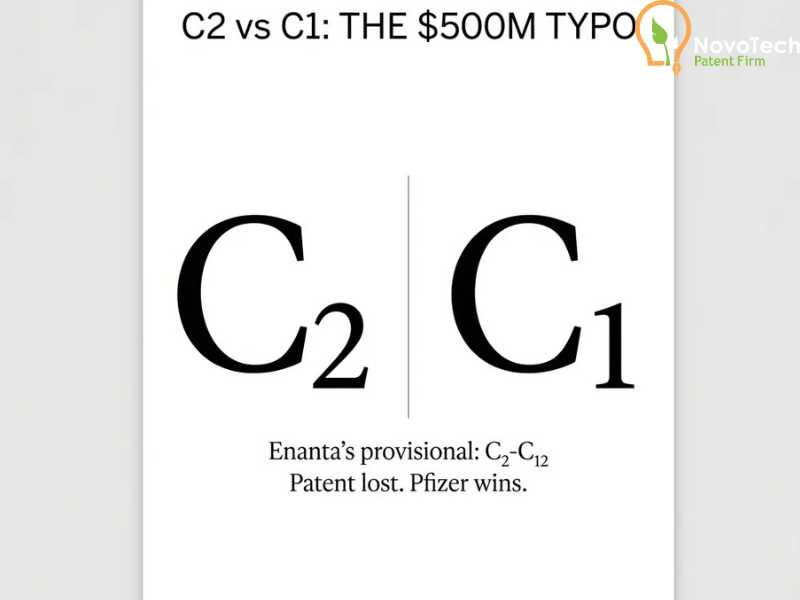
Enanta v. Pfizer FAQ: How One Digit in a Provisional Application Sank a Patent
Authored by Babak Akhlaghi on July 22, 2026. A single subscript. C2 instead of C1.
That is all it took for Enanta Pharmaceuticals to lose its patent fight against Pfizer over one of the most valuable drugs of the pandemic era. In June 2026, the Federal Circuit affirmed that Enanta’s Patent No. 11,358,953 was invalid, anticipated by Pfizer’s own public disclosure of nirmatrelvir, the key ingredient in Paxlovid.
I have read the decision closely, and I want to say something that may be unpopular: the court got it right. Stop blaming the courts. The provisional was the problem.
Below are the questions worth answering about this case, in plain language.
What happened in Enanta v. Pfizer, and why does it matter to me?
Enanta filed a provisional patent application in July 2020 covering coronavirus protease inhibitors. The provisional described a chemical substituent as a C2-C12 alkyl, meaning alkyl groups with two to twelve carbon atoms.
On April 6, 2021, Pfizer publicly disclosed nirmatrelvir. That compound uses a C1 alkyl group, one carbon atom. It sat outside what Enanta’s provisional described.
Enanta says it spotted the discrepancy in July 2021 and filed a non-provisional application listing C1-C12 instead. The patent issued, Enanta sued Pfizer for infringement, and Pfizer answered with a devastating argument: the patent could not claim the provisional’s filing date, because the provisional never disclosed C1. That made Pfizer’s own April 2021 disclosure prior art, and the prior art anticipated every claim.
The patent died. If you file provisionals to secure early filing dates, this case is a direct warning to you.
What is a provisional patent application, and what does it actually protect?
A provisional application is a placeholder filing that secures a priority date. It gives you twelve months to file a full non-provisional application, and it lets you say “patent pending.”
Here is what it protects: exactly what you wrote in it. Nothing more.
U.S. law requires the provisional to include a comprehensive written description of the invention to establish a priority date. A cheap provisional will be expensive later. If a key implementation detail is missing or wrong, your later claims lose the early date for that subject matter, and everything published in between becomes prior art against you.
What is the written description requirement, and how does it apply here?
The written description requirement asks one question: did the application show that the inventor was in possession of the invention on the day of filing?
To claim a provisional’s date, the provisional must describe the later-claimed invention in enough detail that a skilled person can conclude the inventor actually had it. The court’s rule is blunt:
“Entitlement to a filing date extends only to that which is disclosed.”
Enanta’s provisional disclosed C2 through C12. It did not disclose C1. The Federal Circuit held that C2 provides no support for C1, full stop.
How is that different from correcting a typographical error?
These are two separate legal doctrines, and the district court and Federal Circuit approached them differently.
- Typo correction applies to issued patents. A court can fix an error only when the error and its correction are obvious and not subject to reasonable debate.
- Written description applies to priority. It asks what the inventor possessed at filing, regardless of anyone’s intent.
The Federal Circuit reframed the whole case. The dispositive question was possession of the invention, whether the inventors possessed C1 on the provisional’s filing date. Under that standard, Enanta lost cleanly.
Why couldn’t Enanta just argue it was a typo?
Because the correction doctrine sets a high bar. The error must be evident from the face of the document, and the fix must be beyond reasonable debate.
Enanta’s own expert pointed to an inconsistency in the provisional’s general definition of “alkyl,” where the numerals said “C2-C12” while the written words said “one to twelve.” That inconsistency lived in a different part of the specification. The specific substituent at issue said C2, consistently, with no internal contradiction.
💡 Key insight: the specification cut both ways. Some passages hinted at C1, others confirmed C2. Any error open to that much debate fails the “obvious” test by definition.
Why did the ambiguity work against Enanta instead of for them?
This is the painful irony of the case. The partial support made things worse.
An obvious error leaves nothing to argue about. The moment two experts can reasonably debate whether an error exists, the error stops being obvious and stops being correctable. The ambiguity itself became proof that Enanta could not fix the problem.
The court added a second twist. Enanta’s provisional was highly detailed, listing dozens of chemical moieties described with great care. The Federal Circuit essentially said: you described everything so meticulously that we take you at your word. The thoroughness became evidence against the typo theory.
Why couldn’t expert testimony fill the gap?
Because speculation about what an inventor might have envisioned counts for nothing in written description analysis.
Enanta’s expert argued that a skilled artisan would read the definitional inconsistency as spreading through the whole document, converting every C2 into a C1. The court rejected that. Expert opinion about intent cannot substitute for words on the page. Extrinsic evidence cannot vary the plain language of the patent document.
The court’s ethanol analogy makes it concrete: ethanol is a two-carbon alcohol people drink regularly. Methanol is a one-carbon alcohol that is highly toxic. Disclosing one is never a disclosure of the other, even though the structures sit side by side.
Isn’t the written description standard stricter than infringement analysis?
Yes, and that is by design. These are two different questions.
Infringement asks what the claim covers when applied against an accused product. Courts apply reasonableness and the doctrine of equivalents.
Written description asks whether you possessed the invention on the day you filed. It goes to the filing date, the priority date, the foundation of the patent. Lose it, and vast amounts of additional prior art become available against you. In Enanta’s case, the prior art that killed the patent was Pfizer’s own product disclosure.
The stakes justify the stringency. The Juno Therapeutics case shows the scale: a $1.2 billion damage award was reversed entirely on written description grounds.
What does “the provisional is your ceiling” mean in practice?
Everything you claim later must trace back to what the provisional discloses. You can narrow later. You can refine later. Adding subject matter the provisional never described strips that subject matter of the early date.
⚠️ Warning: under the first-inventor-to-file system, whichever inventor files first with adequate disclosure wins. In hot fields such as AI, blockchain, robotics, and pharma, competitors are filing and disclosing constantly. Every gap in your provisional is a window a competitor’s publication can climb through.
What should I do differently when filing a provisional?
Based on this case and my own practice with startups, four things:
- File a strategic provisional. Budget constraints are fine. Rushing is the problem. I once helped a startup with limited funds prepare for an investor presentation. We ran a strategy session and built a lean provisional that captured the core of the invention. They walked into that meeting protected. Enanta shows what happens when the core detail is wrong.
- Have every inventor review and approve the filing. The people who built the technology catch errors that outside reviewers skim past.
- Slow down on the details that carry the invention. In chemistry and biotech, one carbon atom means a different compound with different properties and different commercial value. The smallness is visual, not scientific.
- Watch your competitors. Enanta realized its error only after seeing Pfizer’s product. A competitor’s disclosure became the mirror that revealed the gap, and by then it was too late.
Should I include claims in my provisional application?
Yes. Claims are optional in a provisional, and skipping them is common practice. I teach the opposite.
Drafting at least one independent claim, ideally with several key dependent claims, forces you to define the boundaries of the invention on day one. You cannot write a claim without knowing what the invention actually is. That conversation with the inventors, held early, is exactly what catches a C2 that should have been a C1.
It also gives you a concrete target: you can check that every claim element has written description support before you file, instead of discovering a gap in litigation.
Can AI help me audit a provisional application?
Yes, and I recommend it as an audit layer rather than a drafting tool.
AI is well suited to flag inconsistencies a human eye skips because the text looks right at a glance. Run your specification through it and ask it to catch:
- Mismatches between numerals and written numbers (“C2-C12” next to “one to twelve”)
- Inconsistent use of chemical compounds or defined terms across the document
- Ranges that shift between the definitions section and the claims
Enanta’s error was exactly the kind of internal inconsistency an automated consistency check catches in seconds. The tools exist now. Use them before filing, when correction is still free. However, ensure the AI tool you use includes proper confidentiality and privacy provisions.
Was the Federal Circuit too rigid, or did it get this right?
It got this right.
The court distinguished this case from precedents about correcting obvious errors in issued patents. This error was neither obvious nor located in an issued patent. It sat in the provisional, at the foundation of the priority claim, and the question properly became one of written description.
Some practitioners worry the written description requirement has become a popular defense target with a heightened standard. I understand the concern. In this case, though, the rule protects something important: the public’s right to rely on what was actually disclosed. Pfizer almost certainly got lucky here, since provisionals are unpublished and Pfizer had no way to know about the error. The system still worked, because priority rewards disclosure rather than intent.
The one truth this case teaches
Treat the provisional as the real filing, because legally it is.
Develop it strategically. Include claims. Have the inventors review every detail. Run it through AI before you file.
Your provisional is your ceiling. Enanta v. Pfizer is the proof, and it cost a patent covering one of the most important drugs of the decade. If you are building something real and want to file with that level of rigor, start here.