VDPP v. Volkswagen: The Patent Marking Mistake That Erased Millions in Damages
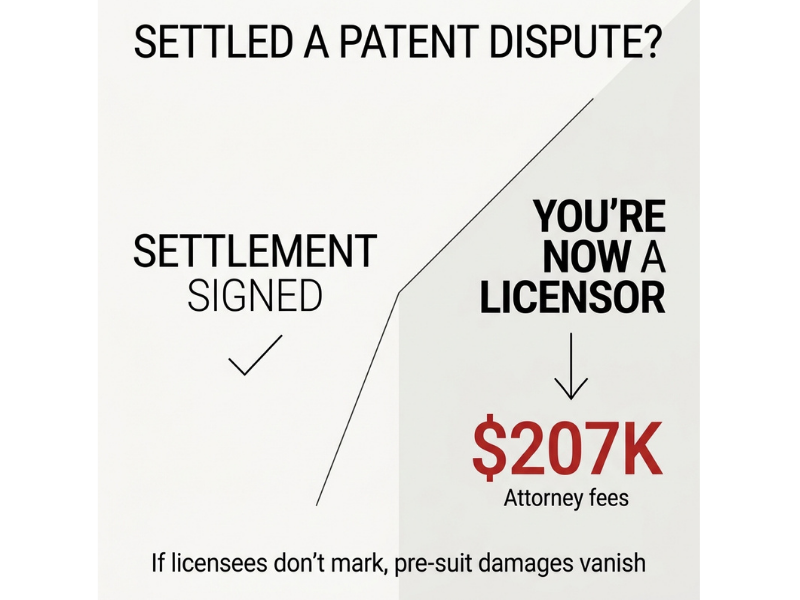
By Babak Akhlaghi on August 31, 2026. You settled a patent dispute. Someone paid you to go away. You signed the agreement, banked the check, and moved on.
Here is what I need you to understand: in the eyes of the law, you just became a licensor. And that status carries an obligation most founders have never heard of.
On August 19, 2026, the Federal Circuit decided VDPP, LLC v. Volkswagen Group of America, Inc., Case No. 24-2226 (Fed. Cir. Aug. 19, 2026) (Moore, Lourie, Cunningham, JJ.). The court affirmed dismissal of VDPP’s infringement suit over U.S. Patent No. 9,426,452, a patent on electrically controlled spectacles. The dismissal was with prejudice. VDPP can never bring that suit again. The court also affirmed a $207,543.60 attorney fee award against VDPP.
The patent was not invalidated. Prior art played no role. VDPP lost on something that looks administrative: patent marking under 35 U.S.C. § 287(a).
The marking statute has real teeth. This case shows exactly where they bite.
The Settlement Trap: A Settlement License Is Still a License
VDPP had signed eleven settlement agreements licensing its patent. To VDPP, those were closed chapters. Disputes resolved, files archived.
The Federal Circuit saw eleven active licensing relationships, each carrying marking compliance obligations.
VDPP argued the licenses were different because they came out of settlements and because no licensee ever admitted infringement. The court rejected both arguments. A settlement license is no different for marking purposes from any other patent license. The court’s own precedent frames a license as a promise not to sue. The label on the document does not matter.
License is a license. That was the court’s framing. Make it your reality check.
The consequence was severe. The ‘452 patent had expired, so the only remedy available was back damages for pre-suit infringement. Because no licensee marked and VDPP failed to plead compliance, those pre-suit damages vanished. With nothing else on the table, the entire case collapsed.
⚠️ Warning: If your patent is near expiration, pre-suit damages are the only damages you have. Marking failures eliminate them entirely.
The NPE Blind Spot: “I Don’t Make Anything” Only Protects You Until You License
Founders don’t actually say this to me — because they don’t know the marking requirement exists at all. The blind spot runs deeper than a misconception. It’s a complete absence of awareness.
That statement is a half-truth, and it is the most expensive half-truth in startup patent strategy.
Here is the accurate version. If you commercialize your patent purely through licensing and nobody makes a product under it, marking does not apply to you. The moment a licensee starts making, selling, offering, or importing a patented product in the United States, the marking obligation follows you. The Federal Circuit was explicit: a patentee’s licensees must also comply with § 287.
VDPP claimed NPE status as a shield. Its amended complaint said it was “a non-practicing entity, with no products to mark.” The court called this a bare legal conclusion and refused to accept it, because VDPP had eleven licensees making products it believed infringed.
Note the direction of the inquiry. It does not matter whether your licensee believes it infringes. The determinative question is what you, the patent owner, believe, and what reasonable steps you took to ensure your licensees marked.
In my experience, this lands like news for most founders. Startups are rarely familiar with the intricacies of the US patent system, and marking sits in a corner of it that nobody mentions until it costs them. That knowledge gap is exactly why I write pieces like this one.
Drafting Is Half the Equation. Monitoring and Enforcement Is the Other Half.
Most founders treat the signed license agreement as the protection itself. The agreement is the starting line.
The VDPP record makes this painfully concrete. Eleven licensees. Zero evidence of any monitoring effort. And one agreement went further: it expressly stated the licensee had no obligation to mark. Someone drafted that clause, and nobody in the room connected it to pre-suit damages years down the road. In litigation, that clause became the first piece of evidence against the patent owner.
The court left one door open. It declined to hold that a licensor can never satisfy the reasonable efforts standard without a marking clause or marking obligation in the license agreement. In VDPP’s case, with no clause and no monitoring, the door stayed firmly shut.
Here is the framework I would give my startup clients. I call it the three-part compliance stack:
- 1. A marking provision in the license. Require your licensee to mark every licensed product with the patent number or a virtual marking URL. This clause is straightforward to draft. Ask your patent attorney to include it.
- 2. An audit provision with a cadence. Quarterly or annually, whatever is reasonable and customary for your industry. The clause gives you the right to verify marking. The cadence forces you to actually use it.
- 3. Consequences for non-compliance. Spell out what happens when a licensee fails to mark. Cure periods, remedies, termination rights.
Then run the stack. A clause you never exercise proves little. Years from now, if a court asks whether you made reasonable efforts, “we had a clause and the licensee ignored it” will fall short. You need a record: audit requests sent, responses received, follow-ups documented.
Drafting is half the equation. Monitoring and enforcement is the other half.
💡 Tip: A shared folder with dated audit correspondence for each licensee is enough infrastructure for an early-stage company. The bar is reasonable effort, and reasonable effort leaves a paper trail.
What This Case Costs When You Get It Wrong
Add up VDPP’s ledger from this one compliance failure:
- All pre-suit damages: gone.
- The case: dismissed with prejudice, unrepeatable.
- $207,543.60 in the other side’s attorney fees: owed.
- The court also found the case exceptional under § 285, citing frivolous positions and repeated errors.
For a startup building revenue around licensing and enforcement, that outcome threatens the entire model. And every piece of it was preventable with clauses that take an afternoon to draft and a monitoring habit that takes hours per year.
Founder FAQ: Patent Marking After VDPP v. Volkswagen
Does patent marking apply to me if I don’t make a product?
If nobody makes a product under your patent, no. Once you grant a license and your licensee makes, sells, or imports a patented product in the United States, the obligation applies through them, and you must make reasonable efforts to ensure they comply.
What are pre-suit damages and why do they matter?
They are damages for infringement that happened before you filed suit, reaching back up to six years. Without marking compliance or actual notice to the infringer, that entire window closes. For an expired patent, pre-suit damages are the only damages, so losing them ends the case.
What happens if my licensee doesn’t mark?
Your pre-suit damages against third-party infringers are at risk. Courts ask what reasonable efforts you made to get the licensee to comply. Documented efforts can save you. Silence, as VDPP learned, will not.
What should my license agreement say about marking?
Three things: a marking requirement covering all licensed products, an audit right with a defined cadence, and stated consequences for non-compliance. Never include a clause relieving the licensee of marking. VDPP had one, and it destroyed the pre-suit damages position.
What is virtual marking?
Instead of stamping the patent number on the product, the licensee marks it with “patent” or “pat.” plus a free, public web address listing the patents covering that product. Virtual marking is especially useful for compact products or software that is delivered digitally. It provides a flexible way to keep patent information current without the cost and disruption of retooling manufacturing or packaging. Section 287(a) expressly permits this approach.
What does “reasonable efforts” actually mean in practice?
The courts decide case by case, and VDPP shows the floor: doing nothing fails. In practice, a marking clause plus periodic audits plus documented follow-up puts you on solid ground. The point is provable action, and your records are the proof.
The Takeaway for Founders
Your obligation extends to your licensees and everyone making the patented article under them. A settlement license counts. Your licensee’s opinion about infringement is irrelevant. Your belief and your documented efforts decide the outcome.
This is a conversation I would have with startup clients before they sign their first license or settlement, because marking has real teeth and the time to comply is before the ink dries.
If you are licensing your patents, settling a dispute, or building an enforcement strategy, get the three-part compliance stack into your agreements now. Bring your existing licenses to a patent attorney who works with startups and have them reviewed before you ever need to enforce. I have seen it playout in real cases. The founders who treat the signed agreement as the starting line keep their damages. That is the whole lesson of VDPP v. Volkswagen.