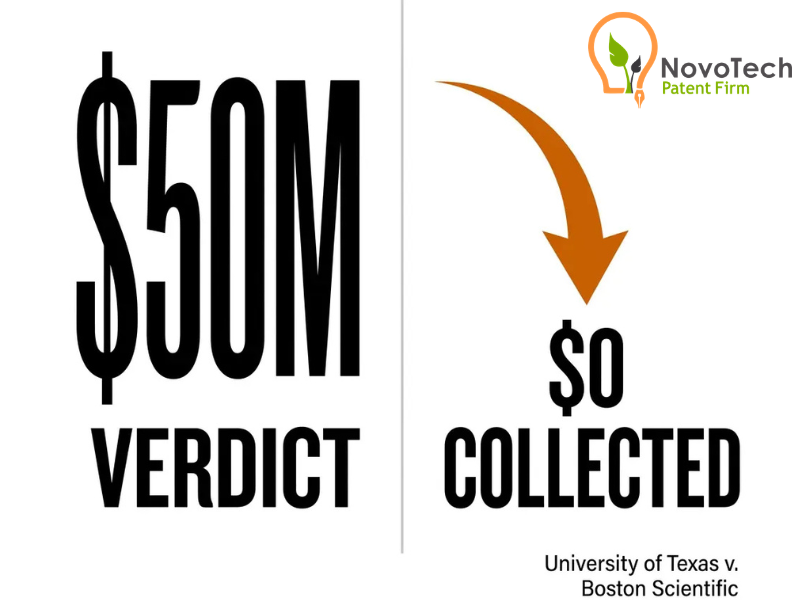
A $50 Million Patent Verdict Vanished on Appeal. Here Is What Founders Should Learn From It.
By Babak Akhlaghi on August 6, 2026. In July 2026, the Federal Circuit erased one of the biggest university patent wins in recent memory. The University of Texas had convinced a Delaware jury that Boston Scientific willfully infringed its drug-delivery patent. The jury awarded damages. The district court entered judgment.
Then the appeals court reversed everything.
The Federal Circuit wiped out the almost $50 million damages award and granted Boston Scientific judgment as a matter of law on two independent grounds: the patent was invalid, and even if it were valid, the product did not infringe it. UT walked away with nothing after nearly a decade of litigation.
I read this decision as a practitioner, and I keep coming back to one question: what should a founder take from this?
The answer sits in a single discipline that is rarely treated as mandatory. The pre-litigation audit.
What the Case Was Actually About
UT owns U.S. Patent No. 6,596,296, which covers a biodegradable polymer fiber with a drug dispersed inside it. As the fiber degrades in the body, the drug releases over time. Think of a thread that slowly dissolves and medicates the tissue around it.
Boston Scientific sells drug-eluting coronary stents. A stent is a tiny metal frame of zigzag rings that props open an artery. Boston Scientific dips and rolls that frame in a liquid drug-containing coating that, in the court’s own words, “dries like paint.”
UT’s theory: a portion of that dried coating, if you sliced it off the metal frame, would qualify as the claimed “fiber.”
The jury bought it. The Federal Circuit did not.
Two Failures, One Case
Failure One: The Claim Was Too Broad to Survive
Anticipation is patent law’s version of “someone got there first.” A claim is anticipated, and therefore invalid, if a single earlier reference discloses every element of it.
Here, that reference was the Song patent, a 1994 patent on gradual-release fibers, more than a decade older than UT’s patent. Song taught a biodegradable polymer fiber. It taught drug-containing regions dispersed through the fiber. It even used the word “immiscible,” the exact term in UT’s claim.
UT’s expert argued that the inventions were different. He described release mechanisms, chewing gum applications, tissue engineering. The problem: none of that lived in the claim.
The claims define the boundary of your invention. The specification is descriptive context. The drawings are illustrations. The expert’s story is testimony. When you compare your patent to prior art, the only thing that matters is what the claim says.
The invention UT’s expert described may genuinely have differed from Song. The claim said something broader, and Song taught every element of it. The Federal Circuit held that no reasonable jury could have found otherwise.
The dependent claims should have been the safety net. Layered dependent claims exist to narrow the independent claim and provide backup positions when the broad claim falls. Here, they added elements Song also disclosed, like “drugs” as a therapeutic agent and “polyglycolic acid” as a polymer. They fell with the independent claim.
Every dependent claim should count. Every dependent claim should tell a story. Every dependent claim should provide a market advantage. UT’s did none of that work when it mattered.
Failure Two: An Infringement Theory That Required a Scalpel
To prove infringement, you must show that the accused product contains every element of your claim. The district court construed “fiber” to mean a thread-like structure.
Boston Scientific’s coating is a dried liquid adhering to a metal frame. To find a “fiber” in it, UT had to imagine cutting out the coating covering a single zigzag ring and treating that stripped-off section as a thread.
The Federal Circuit dismantled this with one analogy:
“One cannot reasonably say that a uniform sheet of paper contains a narrow strip simply because one can cut such a strip from it.”
It’s like saying a sheet of paper includes a strip, because if you slice it, there would be a strip. The coating never existed as an independent structure. It needs a substrate. When your infringement theory requires dissecting the accused product into shapes that exist nowhere in reality, the theory has already failed.
The Mindset Reframe: Patents Are Leverage
Here is the framing I give every founder I work with.
The real value of a patent is the leverage it creates. Leverage with investors, because the idea is defensible. Leverage with competitors, because the space is claimed. Leverage in licensing conversations, because you hold a granted right. If you are still building that foundation, this breakdown of patent strategy for startups covers how to build IP that actually creates that leverage.
Litigation is the failure state. It means the leverage stopped working and you are now spending years and millions to enforce it, with no certainty in the final outcome. Jury wins offer limited comfort, because appellate courts may reverse their findings, exactly as they did here.
UT is a major research university with a sophisticated technology transfer office and top-tier counsel. If a fragile claim can reach trial with those resources behind it, it can happen to any startup.
To be clear: I am not asserting UT skipped its due diligence. We don’t know that. I am asserting that a rigorous pre-litigation audit creates the opportunity to surface both types of weakness — an overly broad claim and an infringement theory under strain — before a lawsuit is filed. Whether Song would have surfaced in that search, nobody can say with certainty. But a focused, adversarial validity search is the mechanism designed to find exactly that kind of reference. Skipping it removes the only real chance to course-correct before the courtroom does it for you.
The Pre-Litigation Audit: Your Bridge From Suspicion to Suit
Think about the patent lifecycle as two mirrored moments of discipline.
Before you file, you run a patentability search to understand the prior art landscape and draft claims that survive it. Before you enforce, you run a pre-litigation audit to understand what an adversary will do to those same claims. Same discipline, two stages of the patent lifecycle.
💡 A proper pre-litigation audit answers three questions:
- Validity: Run a fresh, adversarial prior art search on your own patent. The ocean of prior art is so vast, it’s impossible to find everything, and some references were unpublished when you originally searched. That ocean has only gotten deeper since your patent issued. Treat the search as risk management.
- Claim construction: War-game how a court will interpret your key claim terms. The construction of one word, “fiber,” decided UT’s infringement case. Anticipate that fight before you start it.
- Infringement mapping: Chart every claim element onto the accused product as it actually exists in the market. If your mapping requires slicing, cutting, or hypothetical structures, stop.
The audit also gives you options litigation never will. If you discover a killer reference like Song, you can seek reissue to get narrower claims approved by the USPTO. You can initiate reexamination so the patent office considers the reference, which either strengthens the claims or lets you amend them into a defensible position. Or you simply choose to assert only the claims with the strongest validity position.
Every one of those paths costs a fraction of a trial. Nobody holds a crystal ball, and that is precisely why the due diligence matters rather than an excuse to skip it.
The Sequence Founders Should Follow
When a founder tells me “I think someone is infringing my patent, I want to go after them,” this is the order of operations:
- Infringement analysis first. Map the accused product against your claims, element by element, before any other move.
- Licensing negotiation second. A license reached before suit is the win-win outcome. It converts your patent into revenue without burning years and capital on both sides.
- Pre-litigation audit third. If negotiation fails, stress-test your patent through an adversary’s eyes before you file anything.
- Litigation last. Only with audited, defensible claims, asserted selectively.
⚠️ One more filter: assert seasoned patents. A patent issued at least five years ago carries established expectations in the market and faces higher practical barriers to post-grant challenge. That matters, because petitioners challenging patents at the Patent Trial and Appeal Board succeed at high rates. Age becomes a form of credibility.
Practical Takeaways
- Read your claims, only your claims. The specification describes. The claims define. Compare your claims, word by word, against the prior art and against the accused product.
- Demand layered dependent claims. Each one is a fallback position for the day your independent claim falls in litigation.
- Search before you draft, audit before you enforce. Both are the same discipline applied at different stages.
- Treat a killer reference as a gift. Finding it before litigation lets you fix the patent through reissue or reexamination. Finding it during litigation ends the case.
- Reject any infringement theory that requires dissecting the product. The paper-and-string analogy now lives in Federal Circuit precedent. Courts will use it.
FAQ: What Founders Ask After Reading This
What exactly is “anticipation” in plain English?
A single earlier publication or patent that discloses every element of your claim invalidates it. Your invention counts as already known. The comparison happens between your claim language and the prior art’s teachings, with your intentions and your specification playing no role.
My patent was granted. Doesn’t that mean it’s valid?
A granted patent carries a presumption of validity, and challengers must prove invalidity by clear and convincing evidence. UT’s patent passed examination and still fell, because litigation adversaries search harder than examiners and the prior art ocean keeps growing. Grant is a strong starting position, and it still requires stress-testing before enforcement.
How much does a pre-litigation audit cost compared to litigation?
An audit typically runs in the tens of thousands. Patent litigation regularly consumes many millions per side. The audit is the cheapest insurance in the entire enforcement process.
What do I do if the audit finds damaging prior art?
You have three constructive paths: seek reissue to obtain narrower, stronger claims; initiate reexamination so the USPTO evaluates the reference and issues a hardened patent; or assert only the claims that survive the analysis. Each path strengthens your leverage. Filing suit on a claim you know is fragile destroys it.
Should I ever sue without attempting a license first?
In rare situations, yes, such as a competitor who ignores all outreach or an imminent statutory deadline. In nearly every other case, licensing negotiation comes first. A deal reached before suit preserves capital, relationships, and the patent itself, since litigation invites validity challenges that a license never does.
How do I know if my dependent claims are actually useful?
Ask your attorney to justify each one against the prior art landscape. Every dependent claim should tell a story, add a meaningful technical limitation, and map to a market advantage. If a dependent claim recites something the closest prior art already shows, it provides zero backup protection, which is exactly what happened to UT’s claims 11 and 17.
The Bottom Line
UT won a jury trial in Delaware and still ended with nothing. Years of fights, tens of millions at stake, zero recovery.
Your patent creates value the day it changes a conversation: with an investor, a competitor, or a licensee. Protect that leverage with the same rigor at both ends of the lifecycle. Search before you draft. Audit before you enforce.
The courtroom is where patents go when everything else has failed. Make sure yours never needs the trip.