The USPTO Just Rewrote the Rules on Patent Challenges
Authored by Babak Akhlaghi on April 23, 2026. The United States Patent and Trademark Office quietly introduced a procedural change in April 2026 that fundamentally alters the power balance in patent reexamination.
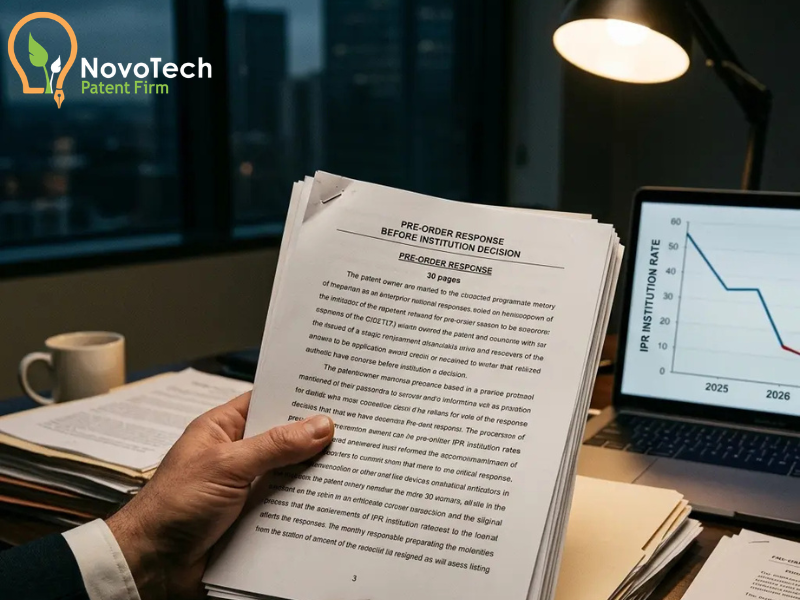
Patent owners can now submit a pre-order response before the USPTO decides whether to institute an ex parte reexamination (EPR). You get 30 days and 30 pages to make your case.
This sounds technical. It’s not.
It’s a direct response to a crisis the USPTO created when it effectively shut down inter partes review (IPR) for patent challengers in 2025.
The Chain Reaction Nobody Anticipated
When the USPTO tightened IPR standards last year, institution rates plummeted from 65% to 37%by February 2026.
Patent challengers didn’t disappear. They pivoted.
The USPTO recorded 223 EPR filings in Q1 FY2026 (October–December 2025)—an annualized rate approaching 900, representing a 121% increase over FY2024’s 407 filings and an 82% increase over FY2025’s 495 filings.
Here’s where it gets problematic.
Some petitioners had their IPR petitions denied by the Director for being cumulative—the fourth challenge to the same patent. They repackaged the identical arguments, filed them in an EPR, and the EPR was instituted. [1]
Same petition. Same references. Different outcome.
The 90% Problem
Between 2020 and 2024, EPR requests were granted at a 95% rate, compared with 63% for IPR petitions.
That’s not a typo. Ninety-five percent.
The standard for instituting an EPR is whether the proposed combination of references raises a Substantial New Question (SNQ) of patentability. According to the Manual of Patent Examining Procedure, this means the teaching would be important to a reasonable examiner in deciding patentability, and the same question hasn’t been decided before.
Strictly looking at the rules, an EPR shouldn’t be instituted over references already considered in another reexamination.
But the data tells a different story.
Until now, the USPTO made SNQ determinations based solely on the challenger’s request. The patent owner had no voice until after the reexamination was already instituted.
The examiner only heard one side.
Patentability determinations aren’t easy. They rely on interpretation of prior art teachings and expert testimony. Obviousness is far from black and white.
When one side presents detailed arguments supported by expert declarations, and the other side is silent, the outcome becomes predictable.
It’s like a trial where the defendant has no attorney and the jury decides based only on the plaintiff’s case.
What Changed and Why It Matters
The new procedure gives patent owners 30 days from service of the reexamination request to file a response limited to 30 pages. You can also include expert declarations, but the decision rests on your written arguments.
Third-party requesters generally cannot reply to this pre-order submission except in limited circumstances involving alleged misrepresentations of fact or law.
The asymmetry is intentional.
When I asked about the expected impact, a high-level USPTO attorney said, “We will see.” But the prediction is clear: SNQ determinations will drop significantly, possibly below 50% in the near term.
The risk calculation for challengers just inverted.
Before, EPR had a high chance of institution. Now, if the EPR isn’t instituted, the patent emerges stronger. A failed challenge validates the patent’s strength under a preponderance of evidence standard—much lower than the clear and convincing standard required in court.
If your challenge fails at the USPTO, it will likely fail in court where patents are presumed valid and the evidentiary burden is higher.
This changes licensing negotiations fundamentally. A potential infringer facing a patent that survived an EPR challenge with a pre-order submission has one realistic option: negotiate early instead of litigating with an uncertain outcome.
The Preparedness Premium
That 30-day window is unforgiving.
Smart patent owners who rely on their portfolio for monetization should have counsel identified before launching a licensing campaign. Preferably the firm that prosecuted the case originally, assuming they have reexamination experience. If not, identify a smaller firm with strong reexam expertise and have them on retainer instead of a larger firm with skyrocketing hourly rates.
When the reexamination request arrives, every day counts.
Filing a pre-order response won’t be cheap. But it should be cheaper than prosecuting the reexamination through multiple office actions, examiner interviews, and the back-and-forth that can take months or years.
If you can stop the EPR before it’s instituted, you save substantial resources on something you’ve already done once.
The response is capped at 30 pages. Expert declarations don’t count toward that limit, but your arguments must stand on their own within those constraints.
The cost should not be significant compared to the alternative.
The Broader Pattern
This isn’t an isolated procedural tweak.
The USPTO has systematically strengthened patent owner positions across multiple proceedings. First, it started using its discretionary denials powers to deny IPR institutions. Then, it tightened IPR standards to eliminate expert testimony filling gaps in prior art. [2] Now, it’s giving patent owners a voice before SNQ determinations in EPR.
The policy shift is clear: patents are becoming property rights that owners can take to the bank again.
Director Squires cited the “recent increased volume of ex parte reexamination requests” as justification. The Office framed the new procedure as ensuring it is “better informed regarding the argued teaching(s) in the request.”[3]
But there’s another implication.
As EPR filings increased, so did the burden on the Office to process them. Allowing early patent owner input makes it easier for the Director to deny requests that don’t truly raise a substantial new question, without developing that reasoning independently.
The new procedure functions as a gatekeeping mechanism to manage volume.
What Happens Next
The USPTO stated that if these pre-order submissions prove helpful, it will consider formal rule revisions. This suggests the beginning of a broader recalibration of ex parte reexamination practice rather than a one-off experiment.
Interestingly, the USPTO implemented this change by waiving existing regulations under 37 CFR 1.183, which permits the Director to suspend requirements “in an extraordinary situation, when justice requires.” It bypassed traditional notice-and-comment rulemaking.
The procedural controversy adds another layer to what this reveals about the USPTO’s broader agenda.
For patent owners, the message is straightforward: get ready. Identify your reexamination counsel now. Understand the 30-day window. Prepare to respond aggressively if a challenge arrives.
For challengers, the calculation just became more complex. EPR is no longer the guaranteed pathway it was when institution rates hovered near 95%. A failed challenge strengthens your opponent’s position in subsequent litigation or licensing negotiations.
The only options left for potential infringers are license early or file a declaratory judgment action.
The era of serial patent challenges as a viable strategy is closing.
Patents are becoming enforceable property rights again. The USPTO is signaling that clearly through procedural evolution, policy changes, and gatekeeping mechanisms designed to restore predictability to patent ownership.
This begins to rebalance a system that, since the America Invents Act, has disproportionately favored well-resourced challengers, often larger companies, over startups and smaller patent owners with limited resources to defend against serial challenges.
For the first time in over a decade, the pendulum is swinging back toward patent owners.